Fin Speaks 45 Languages. Your Help Center Doesn't.
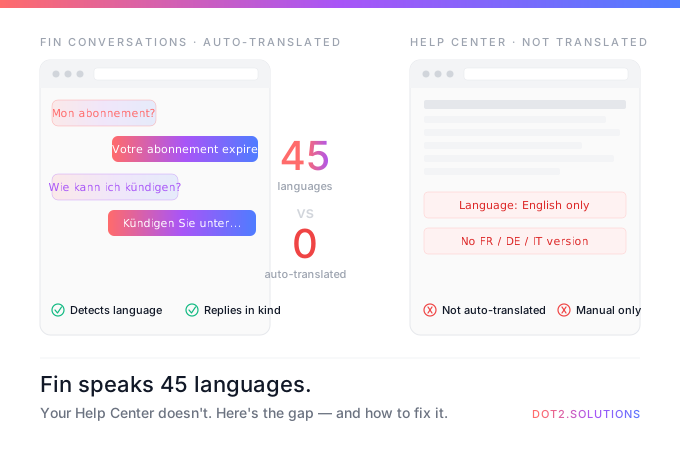
Most Intercom users enable multilingual Fin, see "45 languages supported," and assume their support is covered in every market they serve. There's a gap between what Fin translates automatically and what it doesn't — and it's quietly affecting every answer Fin gives outside your default language.

Chris
May 24, 2026 · 6 min read
Ask AI about this post



Most Intercom users enable multilingual Fin, see "45 languages supported," and assume their customer support is covered in every market they serve.
It isn't.
There's a gap between what Fin translates automatically and what it doesn't — and if you're running a multilingual support operation, that gap is quietly affecting the quality of every answer Fin gives in languages other than your default.
Here's exactly what gets translated, what doesn't, and what to do about it.
What Fin actually translates automatically
To be clear: Fin's multilingual capabilities are genuinely impressive. Out of the box, with the right configuration, Fin handles:
Conversations — Fin detects the language a customer writes in and replies in that language. Enable real-time translation in your Fin settings and it will search your content in your fallback language and translate the response on the fly. A customer writes in German, Fin answers in German. No setup per language required.
Workflow messages and reply buttons — As of late 2025, Intercom's multilingual workflows automatically translate chat messages and reply buttons into every language your workspace supports. One toggle in the workflow editor. Done.
Agent inbox — AI Inbox Translation lets your support agents read and reply in their own language while customers see everything in theirs. Real-time, both directions.
This is genuinely useful. For most conversational interactions, Fin handles multilingual without you needing to do anything beyond configuration.
So what's the problem?
What doesn't get translated — the gap
Here's the part Intercom's marketing doesn't lead with:
Help Center articles are not automatically translated.
Intercom's own documentation is explicit about this: "Though the Help Center can be configured to work in multiple languages, Articles themselves are not automatically translated in Intercom."
That means:
- Your knowledge base articles — EN only, unless you manually create translated versions
- Your documentation — EN only
- Your structured support content — EN only
- The exact content Fin pulls its answers from — EN only
This is not a minor edge case. It's the core of how Fin works.
When a customer asks Fin a question in French, Fin searches your available content for the answer. If real-time translation is enabled and there's no French content, it falls back to your default language (usually English) and translates the response. It works — but Fin is translating on the fly from English source material, not from a carefully maintained French knowledge base.
The quality difference matters. Translated-on-the-fly answers from English content are not the same as answers drawn from accurate, human-reviewed French articles. Edge cases, local terminology, product-specific language — these all degrade when Fin is working from a single-language knowledge base across 45 markets.
Why this matters for CX
Think about what your Help Center is actually for.
There are two distinct customer journeys happening on your support content:
Journey 1 — The Fin conversation. Customer asks a question. Fin answers. Fast, automatic, resolved. This is where Fin's 45-language capability shines. The customer never sees the underlying article — they just get an answer.
Journey 2 — The self-service reader. Customer lands on your Help Center directly. They search, browse, click through to articles. They read. They want to understand your product, your policies, your process — in their language, in depth.
Fin handles Journey 1 remarkably well even with single-language content. Journey 2 is where the gap becomes visible. A French-speaking customer who clicks through to a Help Center article and finds it in English is not having a multilingual CX. They're having an English CX with a French chatbot in front of it.
For Swiss companies in particular — where FR, DE, IT, and EN are all legitimate business languages — this is not a theoretical problem. It's a daily reality.
The fix: Fin does the conversation. Crowdin does the content.
The solution isn't to abandon Fin's multilingual capabilities — they're real and valuable. The solution is to treat the conversation layer and the content layer as two separate problems requiring two separate tools.
Fin handles the conversation layer. Real-time translation, multilingual workflows, agent inbox translation — all of this works well out of the box with proper configuration.
Crowdin handles the content layer. Crowdin connects directly to Intercom Articles and keeps your knowledge base in sync across languages automatically. New articles flow into translation. Updated content triggers a re-translation workflow. Translated articles come back into Intercom without anyone managing it manually.
The result: Fin answers in 45 languages, pulling from a knowledge base that's actually maintained in those languages. The conversation is fast and automatic. The content behind it is accurate and consistent.
This is the setup we implement for Swiss companies running Fin across FR, DE, IT, and EN markets — and it's the reason we added Crowdin to our service stack alongside Intercom.
What to do next
If you're running Intercom Fin in a multilingual market, check three things:
- Is real-time translation enabled? Go to Fin AI Agent → Fin settings → General → Fin's multilingual support. If it's off, Fin won't translate at all for languages where you don't have content.
- Do your Help Center articles exist in your supported languages? Go to your Help Center and check whether translated versions of your key articles exist. If they don't, Fin is working from English source material for every non-English customer.
- Is there a process for keeping translated articles in sync? New articles, updated policies, product changes — if your translation process is manual or batch-based, you already have a backlog building.
If the answer to questions 2 or 3 is "no" or "not really," that's the gap. And it's fixable.
We implement Crowdin for Intercom-based teams across Switzerland. If you're running Fin in a multilingual market and want the content layer to match the conversation layer, let's talk. Or explore our Localization & Crowdin implementation service to see exactly how we set this up.
Sources:
Frequently asked questions
Still have questions?
Where this fits in our work
Practical next steps if this article maps to something you're building.
- Intercom & Fin implementationSilver partner work: Fin deployment, knowledge architecture, workflow design.See the Intercom service
- Try Fin liveAsk our own Fin agent a real question and see how the answers hold up.Open the demo
- Localization & multilingual supportCrowdin pipelines, translated help centers, multilingual AI answers.See localization
Share this article
Need Help with Intercom & Fin?
As an Intercom Silver Partner, we specialise in Fin deployment, knowledge base architecture, and AI support automation for Swiss SMEs.
No commitment required • Free 30-minute consultation • Expert guidance