Claude Fable 5 Disabled by US Government: What It Means for Your AI Customer Service
On June 12, 2026, Anthropic pulled Claude Fable 5 and Mythos 5 overnight on government orders. Here's what happened, why it matters for European businesses, and what resilient AI customer service actually looks like.

Chris
June 13, 2026 · 6 min read
Ask AI about this post




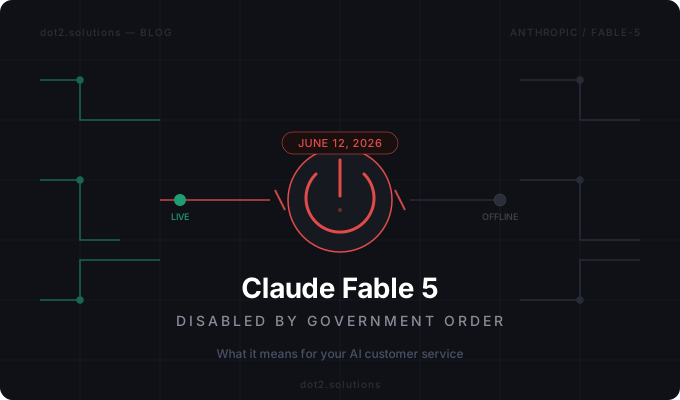
On June 12, 2026, Anthropic was forced to pull the plug on its two most powerful AI models overnight. Claude Fable 5 and Claude Mythos 5 were disabled for all customers worldwide following a US government export control directive citing national security authorities.
Anthropic received the order at 5:21 p.m. ET, instructing it to suspend access for any foreign national — including its own employees. The models had launched on June 9 and were pulled on June 12 — a lifespan of just three days. No warning. No transition period. One directive, and they were gone.
If your business had bet its customer service automation on Claude Fable 5, you'd have woken up Friday morning with a broken workflow and no fallback.
This is exactly the kind of event the AI industry has been warned about. And it raises a question every business deploying AI tools needs to answer: what happens when the model you depend on disappears overnight?
What Actually Happened
Fable 5 was state-of-the-art on nearly all tested benchmarks, showing exceptional performance in software engineering, scientific research, and complex long-form tasks. It was Anthropic's most capable publicly available model — ever.
Unable to filter foreign nationals from US users in real time, Anthropic shut both models down for everyone to ensure compliance. Access to all other Claude models — Opus 4.8, Sonnet 4.6, Haiku 4.5 — remained unaffected.
This appears to be the first government-forced takedown of a publicly deployed frontier AI model. It won't be the last.
For European and Swiss businesses in particular, the lesson is stark: you are a "foreign national" under US export law. Any model subject to US jurisdiction can be switched off for you at any moment, for reasons that may never be fully explained.
The Risk Nobody Talks About
The AI industry loves to discuss model quality — benchmarks, resolution rates, reasoning depth. What gets far less attention is model availability and geopolitical exposure.
Every major frontier model — GPT, Gemini, Claude — is subject to US jurisdiction. That means US export controls apply. When a government directive arrives, compliance is not optional, and the timeline is immediate.
For businesses in Switzerland, Germany, France, or anywhere outside the US, this creates a dependency risk that has nothing to do with model performance. Your AI-powered customer service could go offline not because the technology failed, but because a government order arrived on a Friday afternoon.
The Claude Fable 5 situation made this concrete in a way no analyst report ever could.
Why Domain-Specific AI Is More Resilient
This is where Intercom's recent investment in vertical AI becomes particularly interesting.
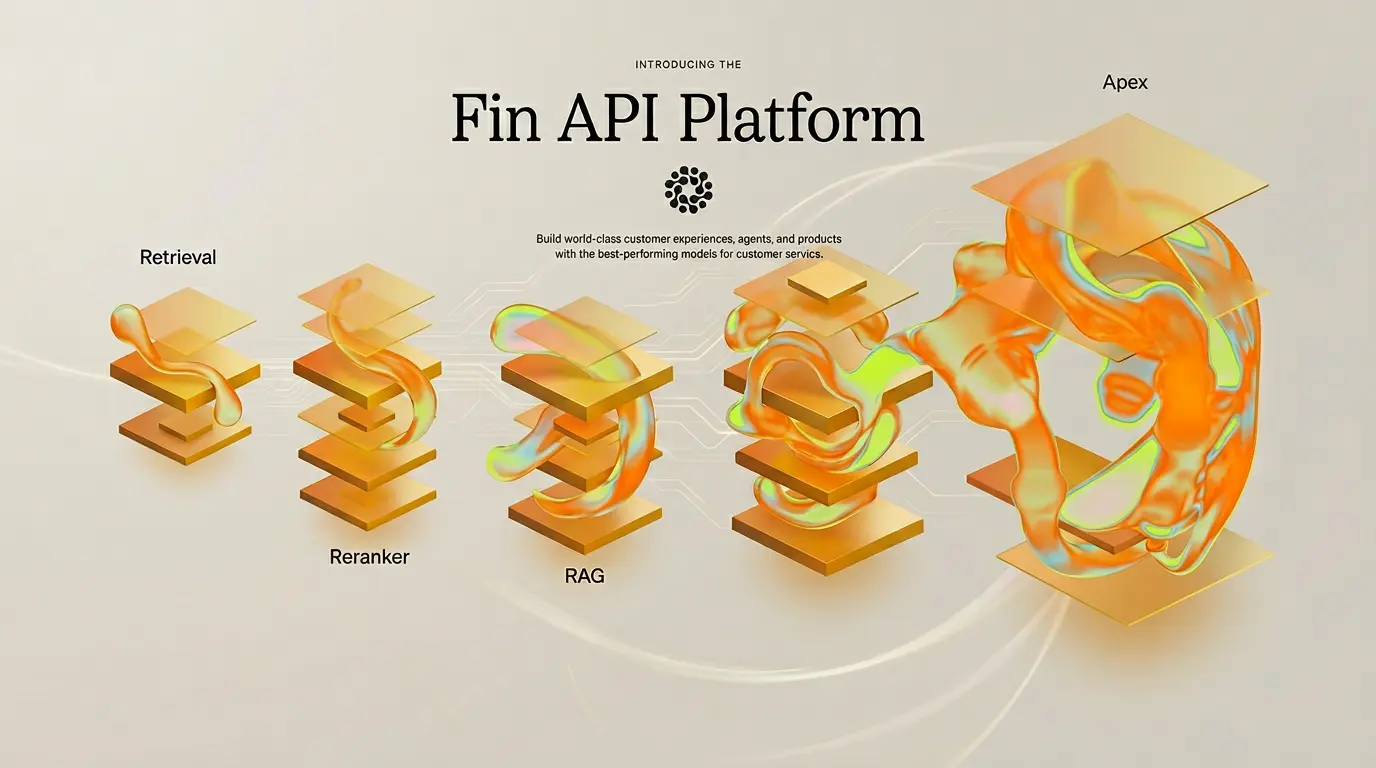
In March 2026, Intercom shipped Fin Apex — a brand new model trained by its internal AI Group specifically for customer service. It's custom-built on proprietary data from millions of real support interactions, and it outperforms leading frontier models on the metrics that matter: resolution rate, speed, and hallucination reduction.
Fin Apex 1.0 achieves a 73.1% resolution rate, compared to 71.1% for both GPT-5.4 and Claude Opus 4.5, and 69.6% for Claude Sonnet 4.6. It delivers responses in 3.7 seconds — 0.6 seconds faster than the next-fastest model — and exhibits 65% fewer hallucinations than Claude Sonnet 4.6.
And for speed-critical use cases, there's now Apex Flash — a new version of the flagship Apex model built for latency-sensitive tasks, fine-tuned for customer service, grounded in customer knowledge bases, and trained to follow policies and escalate correctly. Apex Flash now powers Fin Voice 2, the fastest and most natural AI voice agent on the market.
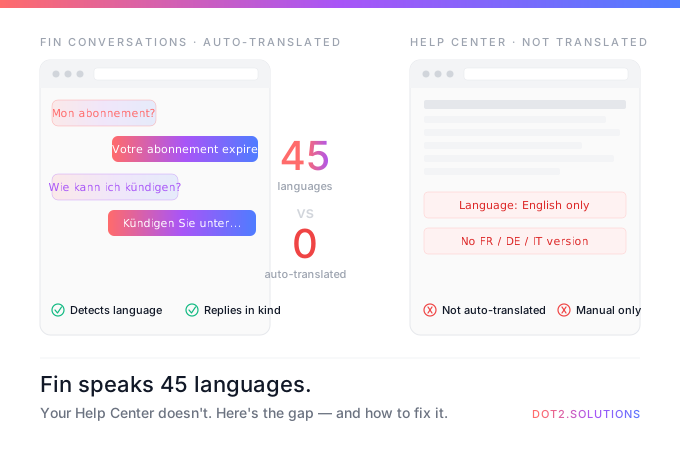
The key architectural difference: Apex and Apex Flash are not general-purpose frontier models subject to export controls. They're domain-specific models embedded inside Intercom's own infrastructure, trained for one purpose, and not exposed to the same geopolitical risk profile. Fin already speaks 45 languages natively and plugs into your existing stack through its API platform.
What Resilient AI Customer Service Looks Like
The Claude Fable 5 shutdown illustrates three principles every business should apply when deploying AI in customer-facing roles:
Single-model dependency is a liability. If your workflow breaks the moment one model goes offline, you don't have an AI strategy — you have a fragile integration.
Domain-specific beats general-purpose for production use. Fin Apex outperforms frontier models on customer service tasks because it was trained for that purpose. Specialisation is not a limitation — it's a competitive advantage.
Geopolitical exposure is a real operational risk. For non-US businesses, every US-jurisdiction model carries regulatory risk. Build with that in mind.
At dot2.solutions, we deploy Fin for Swiss SMEs across support, sales, and onboarding. The Claude Fable 5 situation reinforces why we don't build brittle, single-model pipelines. Fin's Apex architecture provides natural resilience: Apex handles core answering, Apex Flash handles speed-critical flows, and the underlying system routes around availability issues automatically.
The Bottom Line
For any business currently evaluating AI for customer service, the question isn't just "which model is most powerful today?" It's "what happens to my business when that model is unavailable tomorrow?"
The answer to that question just got a lot more concrete.
If you're running customer service in Switzerland and want to understand how Fin can work for your business — without the dependency risk — book a call with dot2.solutions →
Sources & Further Reading
The story
- Anthropic — official statement
- CNBC — Anthropic disables Fable 5 and Mythos 5
- 9to5Mac — Anthropic pulls Claude Mythos 5 and Fable 5
Fin Apex
- Intercom — Announcing Fin Apex
- fin.ai — Fin Apex model page
- VentureBeat — Benchmarks detail
- Opus Research — Analysis
Apex Flash / Fin Voice 2
Frequently asked questions
Still have questions?
Where this fits in our work
Practical next steps if this article maps to something you're building.
- Intercom & Fin implementationSilver partner work: Fin deployment, knowledge architecture, workflow design.See the Intercom service
- Try Fin liveAsk our own Fin agent a real question and see how the answers hold up.Open the demo
- Pricing & engagement modelsTransparent rates for audits, implementation sprints and ongoing support.View pricing
Share this article
Need Help with Intercom & Fin?
As an Intercom Silver Partner, we specialise in Fin deployment, knowledge base architecture, and AI support automation for Swiss SMEs.
No commitment required • Free 30-minute consultation • Expert guidance